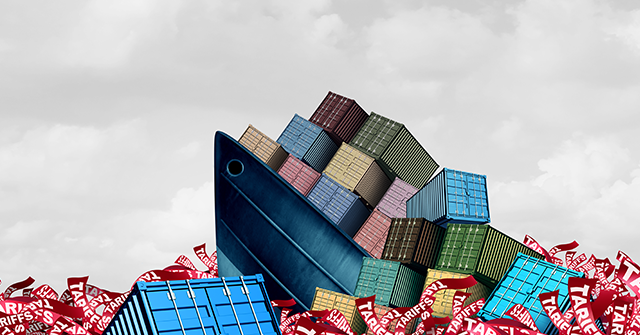
By mid-2025, America has racked up more than $200 billion in import tariffs—cash flowing straight into the Treasury and driving down our federal deficit. Yet a recent German analysis claims that U.S. businesses and consumers shoulder 96 percent of these costs, branding tariffs an “own goal.” That assertion falls apart under scrutiny.
The Statistical Mirage
That 96 percent figure rests on a coefficient barely different from zero. In plain language: the data are noisy, the margin of error enormous. Marginal significance at the 10 percent level does not justify claiming near-perfect pass-through to American buyers.
Disappearing Factories, Not Prices
When tariffs hit, low-cost suppliers vanish. The average unit value jumps, even if every supplier quietly cuts prices. You’re no longer comparing apples to apples—you’ve thrown out the cheapest apples and kept the most expensive ones. The result is a misleading spike in average prices, not proof that tariffs land entirely on U.S. shoulders.
Measurement Handcuffs
Tariffs are imposed on hyper-specific product lines. The German study lumps items into broad categories, averaging 10 percent and 50 percent tariff lines together. That degree of measurement error biases results toward “no effect”—exactly the outcome the authors misinterpret as full pass-through.
Untested Retail Claims
The study leaps from import-price changes to consumer burdens without examining a single shelf price or corporate profit margin. U.S. wholesalers and retailers could absorb levies, or exporters may decide to shave profits. Claiming consumers pays, end of story, is speculation, not analysis.
Ignoring the Enemy’s Distortions
If decades of foreign subsidies, state-backed loans and forced technology transfers have already warped global markets, then U.S. tariffs may correct, not compound, distortions. Basic welfare economics warns: eliminating one distortion in a distorted world can improve overall efficiency. The German analysis never entertains that possibility.
Trade Diversion’s Double Standard
When America raises tariffs on one country, importers pivot to other producers. That shift pushes up prices for non-tariffed exporters, contaminating any “control group.” If both groups see price increases, the difference looks small—but that says nothing about who really paid the levy.
Real-World Results
Tariffs have delivered record-high domestic steel output and revitalized once-dying factories. They’ve forced adversaries to rethink unfair practices and come to the negotiating table. Meanwhile, our border deficit shrinks. These concrete wins counter any abstract metric that ignores supply-chain resilience and strategic advantage.
The Bottom Line
No credible evidence shows that American importers and consumers bear 96 percent of tariff costs. Statistical noise, product-mix shifts, measurement errors and untested retail assumptions doom that claim. In reality, tariffs are a powerful tool to protect U.S. industry, correct foreign distortions and bolster our bottom line. Reject the smokescreen—and stand firm for America’s economic interests.